Featured

Getting My Building a Personalized Financial Recovery Roadmap To Work
Table of Contents
That liberates cash in the short-term, and you may have 3 to four years to conserve toward the settlement quantity. Very unsafe to credit report, mostly because of missed repayments and an adverse "worked out" mark that can remain on your debt record for as much as seven yearsMay be only choice if other alternatives (debt loan consolidation, equilibrium transfer charge card, debt mercy) aren't possibleTypically needs a charge to the 3rd party, which might offset some or all of the financial savings from financial obligation settlementMay assist you avoid bankruptcy if you've missed out on numerous paymentsNot all creditors deal with debt negotiation companies Financial debt forgiveness may be best for you if you are experiencing an economic difficulty that makes it almost impossible to pay for your debt equilibriums.
With a DMP, you make one regular monthly payment to the credit score counseling agency. Those funds are then dispersed to lenders of your unprotected financial debts, such as charge card and installment car loans. The company deals with your financial institutions to reduce rate of interest prices or forgo costs, but some financial institutions might reject such concessions.
It can help you pay down financial debt if you're able to safeguard a funding price that's reduced than the typical rate of the accounts you're consolidating. You need to avoid from racking up financial debt on those freshly gotten rid of accounts or your financial debt could expand also greater.
These cards usually supply a 0% rate of interest initial duration of up to 21 months. That provides you lots of time to eliminate or considerably decrease your balance while making interest-free repayments. For some individuals encountering impossible debt, personal bankruptcy might be the only method to stop collection process and legally settle their financial obligations.
Some Of The Benefits and Cons of Debt Forgiveness
You may need it if your financial institution or a collection agency ever tries to accumulate on the debt in the future. When a lender forgives $600 or more, they are called for to send you Kind 1099-C.
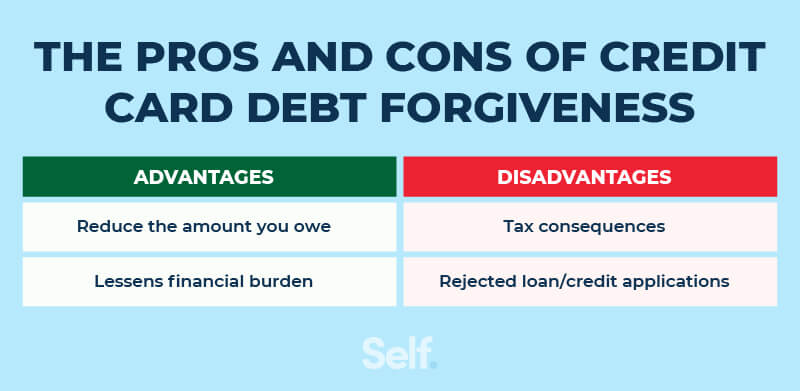
Debt forgiveness or settlement usually harms your credit scores. Anytime you clear up a financial debt for less than you owe, it might show up as "resolved" on your debt report and impact your credit history for 7 years from the date of settlement. Your credit can also go down considerably in the months causing the forgiveness if you fall back on settlements.
When Professional Guidance Makes a Difference Fundamentals Explained
Tax obligation financial obligation concession programs Tax financial debt occurs when the quantity of tax obligations you owe surpasses what you have actually paid. This circumstance usually results from underreporting income, not submitting returns on schedule, or inconsistencies discovered throughout an IRS audit. The consequences of accumulating tax obligation financial obligation are major and can include tax obligation liens, which give the IRS a lawful claim to your home as safety and security for the financial debt.
Incomes and Financial institution Accounts IRS can impose (confiscate) earnings and bank accounts to please the financial obligation. Residential property Seizure In extreme instances, the Internal revenue service can seize and offer home to cover the financial debt.
Clinical depression, stress and anxiety, and various other mental health concerns. Social Preconception Dealing with lawsuit from the IRS can lug social preconception. Damages to reputation and partnerships. Work Opportunities A bad credit history as a result of tax financial obligation can limit employment possibilities. Trouble searching for or keeping a task. Government Advantages Tax obligation financial obligation may impact eligibility for government benefits, such as Social Protection and Medicaid.
Examine This Report about Complimentary Accessible Debt Counseling Resources Provided by APFSC
The OIC considers numerous elements, consisting of the taxpayer's earnings, expenses, asset equity, and capability to pay. Effectively working out an OIC can be complicated, needing a comprehensive understanding of the internal revenue service's standards and a solid disagreement for why your deal straightens with your capability to pay. It is very important to note that not all applications are accepted, and the process calls for thorough economic disclosure.
The IRS evaluates your total monetary situation, including your income, expenditures, property equity, and ability to pay. You have to likewise be existing with all filing and repayment demands and not be in an open bankruptcy case. The internal revenue service additionally considers your conformity history, assessing whether you have a record of timely declaring and paying tax obligations in previous years.
Unknown Facts About How to Get Started Today
The application process for an Offer in Compromise includes several detailed steps. Initially, you have to complete and submit IRS Kind 656, the Deal in Concession application, and Form 433-A (OIC), a collection information declaration for people. These types require extensive financial information, consisting of information concerning your income, debts, expenditures, and properties.
Back tax obligations, which are unpaid tax obligations from previous years, can considerably boost your total internal revenue service financial obligation if not resolved promptly. This debt can accumulate interest and late repayment penalties, making the original amount owed much bigger in time. Failure to repay tax obligations can result in the internal revenue service taking enforcement activities, such as releasing a tax obligation lien or levy against your residential or commercial property.
It is necessary to resolve back tax obligations as soon as feasible, either by paying the total owed or by arranging a layaway plan with the internal revenue service. By taking proactive steps, you can stay clear of the accumulation of additional passion and penalties, and protect against more aggressive collection activities by the internal revenue service.
One usual reason is the idea that the taxpayer can pay the sum total either as a swelling amount or through a settlement strategy. The IRS likewise considers the taxpayer's earnings, expenditures, property equity, and future earning possibility. If these aspects suggest that the taxpayer can afford to pay greater than the supplied amount, the IRS is most likely to deny the offer.
Excitement About The Benefits to Consider When Considering Bankruptcy
Dealing with IRS financial obligation can be complex and complicated. Tax obligation experts, such as CPAs, tax obligation attorneys, or signed up agents, can offer important support.

Table of Contents
Latest Posts
Not known Facts About Recent Laws That Could Change Debt Relief Availability
Getting My Building a Personalized Financial Recovery Roadmap To Work
Is Bankruptcy Suitable for Your Situation for Dummies
More
Latest Posts
Not known Facts About Recent Laws That Could Change Debt Relief Availability
Getting My Building a Personalized Financial Recovery Roadmap To Work
Is Bankruptcy Suitable for Your Situation for Dummies